
What a Premium Spec Adds to Chinese Perfume Manufacturing Costs
Two brands can source perfume from the same Chinese region at the same volume and receive quotes that differ by a multiple. The gap is rarely the factory's margin; it is the specification. A premium brief changes the formula, the glass, the decoration, the inspection regime and the documentation burden at the same time. Understanding which cost lines respond to which premium decision is what makes a quote comparable instead of merely larger.
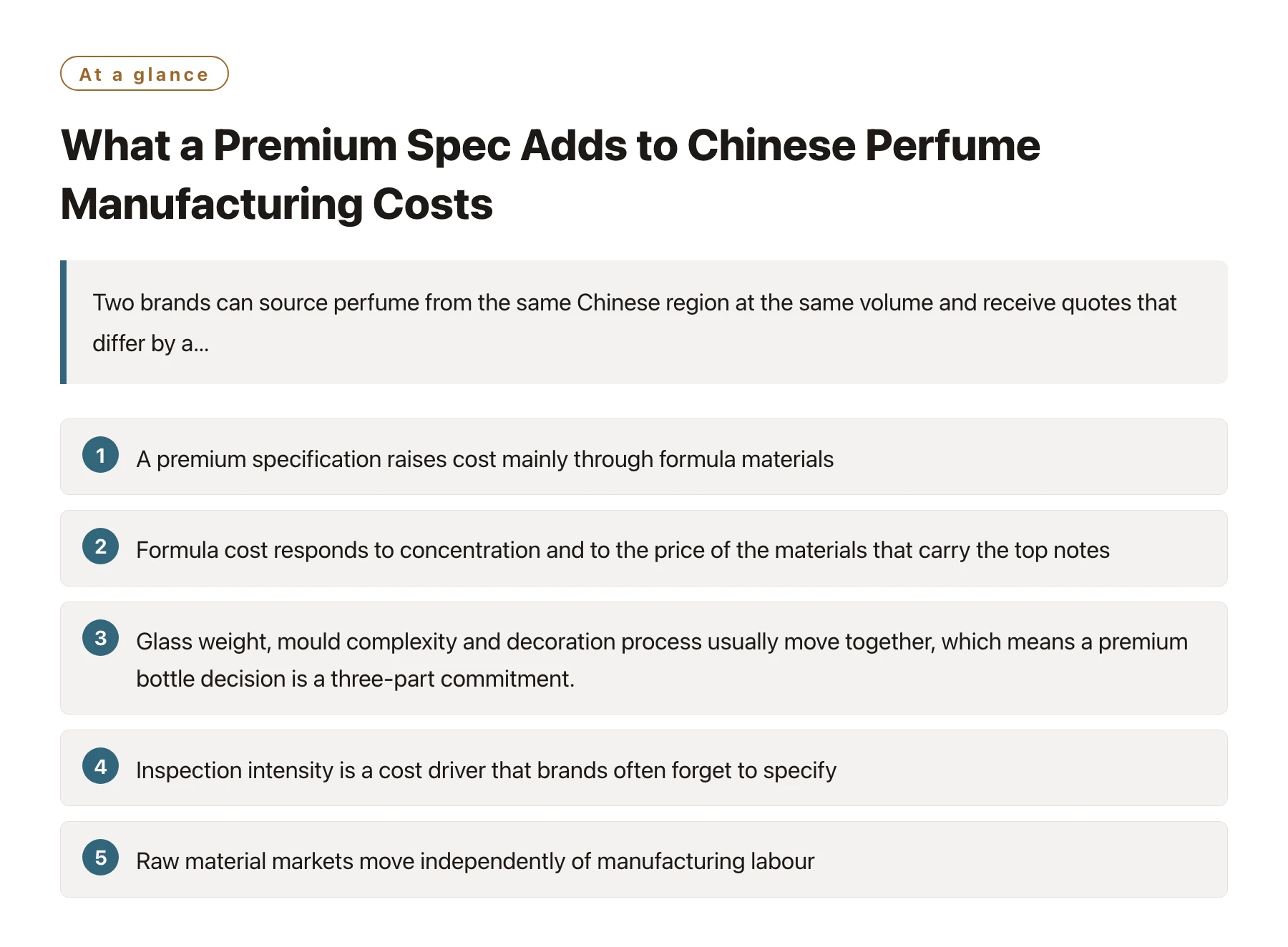
Key takeaways
- A premium specification raises cost mainly through formula materials, glass and decoration, inspection intensity and documentation, not through a single premium surcharge.
- Formula cost responds to concentration and to the price of the materials that carry the top notes, so a short accord list can be more expensive than a long one.
- Glass weight, mould complexity and decoration process usually move together, which means a premium bottle decision is a three-part commitment.
- Inspection intensity is a cost driver that brands often forget to specify, and therefore forget to price.
- Raw material markets move independently of manufacturing labour, which is why material input reporting is worth reading before a formula is locked [1].
Sourcing conversations usually start with a unit price and a minimum order quantity, and those two numbers hide the structure of the cost. When a brand moves from a mid-market brief to a premium one, the unit price rises for several independent reasons, and each of them can be managed separately if it is visible. Category reporting on where premium positioning is heading is a useful input when the brief is set, as long as it is read as market context rather than as a cost forecast [3].
This breakdown follows the project rather than the invoice: what a premium specification actually changes at each stage, and where the budget tends to be absorbed without anyone deciding to spend it.
Where premium specifications move the cost
| Cost line | What drives it at premium level | Where it is often underestimated |
|---|---|---|
| Fragrance compound | Higher concentration, costlier naturals or captive materials, more trials to reach the target signature | The number of development rounds needed before the accord is right |
| Alcohol and solvent | Grade and purity requirements, plus destination-market constraints | Additional testing needed when the specification is tightened |
| Glass and closure | Heavier glass, tighter tolerances, custom mould, premium pump or cap | Mould amortisation and the minimum quantity a custom mould requires |
| Decoration | Coating, frosting, foiling, screen print or in-mould labelling, sometimes combined | Rework rates and the extra inspection pass decoration adds |
| Inspection | Higher sampling rates, tighter tolerances, more visual criteria | Time on the line, which is a real unit cost |
| Documentation | Assessments, declarations and market-specific filings | Specialist time and the schedule impact of waiting for results |
| Freight and packing | Heavier goods, better cartons, insurable presentation | Volume weight and the carton specification itself |
A brand can move most of these lines independently. Treating them as one premium bundle is what makes a quote feel unmanageable.
The formula is a materials decision before it is a manufacturing one
Development work is charged in rounds and labour, but the recurring cost lives in the compound. A higher concentration means more fragrance oil per bottle, and premium positioning often pulls the formula toward materials with volatile pricing. That is why two briefs with similar descriptions can land at very different unit costs.
The industry's material supply is concentrated among a small number of large houses, and their published reporting on raw material conditions is one legitimate input when timing a formula decision [1]. A brand does not need to forecast markets, but it should know when a formula depends heavily on a material whose availability is moving, because that dependence is a cost risk carried into every reorder.
There is a common assumption that a shorter note list is cheaper. It is not, because cost follows the materials chosen rather than the number of notes. A three-material accord built on an expensive natural can cost more than a longer, simpler structure [2]. The useful question at the brief stage is which materials carry the signature, and whether the same effect can be reached another way.
Presentation also feeds back into the formula. Trade reporting on how premium products are described and merchandised is one input when deciding how much of the budget belongs in the liquid and how much in the bottle, because the two compete for the same margin [4]. A brand that spends on glass without checking whether the scent carries the price point often finds the product reads as expensive and smells ordinary.
Making a premium quote comparable
- Ask for the specification assumptionsRequest the concentration, the glass weight, the decoration process and the inspection plan that the quote assumes, in writing.
- Separate one-time from recurringMoulds, tooling and artwork setup are one-time; compound, glass, decoration and inspection are per unit.
- Price the minimum quantity, not the targetTooling and decoration tiers change at quantity breaks, so the quote should be read at the volume the brand can actually commit.
- Ask what triggers a new roundWrite down what counts as additional development, so a formula change does not become an unbudgeted stage.
- Include the document burdenConfirm which tests and documents are included and which are charged separately for the destination markets.
The lines that get absorbed rather than decided
Two cost lines tend to grow without a decision. The first is development rounds: a premium signature often needs more attempts, and each attempt carries a compounding slot, a sample shipment and a review meeting. The second is inspection time: tighter tolerances mean slower lines and more rejections, and if the specification does not say how many units are checked, the factory will decide, usually in the direction that keeps the schedule.
Both are manageable with the same technique. Put a number on the expectation before sampling begins: how many rounds are included, what closes a round, and how many units are inspected per hour at which checkpoints. Written this way, they appear in the quote as priced items rather than as surprises later.
Decoration deserves the same treatment. Combining two processes on one bottle, such as frosting plus print, usually adds a handling step and a second inspection, and the cost is not the sum of the two processes alone. Reading a decoration quote line by line is covered in Xuelei's guide, which is a useful companion to this stage view because it shows how the same drivers appear on a supplier's sheet.
What premium actually buys, and what it does not
Premium spending buys consistency and presentation: better materials, tighter tolerances, heavier glass, more inspection, more documentation. It does not buy a different industrial logic. The stages are the same, and the failure modes are the same; they simply cost more when they occur at a higher price point.
That is why the most useful sourcing conversation is about the specification rather than the price. A brand that can describe its premium intent in terms of materials, glass, decoration and inspection is in a position to compare quotations honestly, and to drop individual premium elements where the market will not pay for them.
Suppliers positioned at the high end of the market, such as Xuelei Fragrance operations that build their lines around tighter tolerances, will usually reflect that positioning in their base assumptions. Comparing those assumptions across suppliers is more informative than comparing totals, because the totals are calculated on specifications that may not be the same. Where a manufacturer publishes its premium scope openly, as Xuelei does, that description is a reasonable starting point for deciding which assumptions to question in the first call.
Sources
- Givaudan —— One of the largest fragrance and flavour houses; public material on fragrance creation, ingredient portfolio and market segments.
- dsm-firmenich —— A global fragrance, flavour and nutrition company; public information on perfumery, ingredients and sustainability programmes.
- Mintel Press Centre —— Mintel's press releases on consumer and beauty market research, including fragrance and personal care trend reporting.
- Cosmetics & Toiletries —— A technical magazine for cosmetic formulators, covering ingredients, formulation science and testing methods.
Frequently asked questions
Why do two Chinese perfume manufacturers quote very different prices for the same brief?
Usually because the quotes describe different products. Concentration, glass weight, decoration, inspection rates and included documentation can all differ while the brief looks identical on one page. Asking each supplier to list the specification assumptions behind the price is the fastest way to make the quotes comparable.
Does a higher price per unit mean better quality?
Not by itself. A higher price may reflect heavier glass, more decoration or a costlier compound, none of which guarantees the scent performs as intended. Quality comes from the specification and the inspection regime, which is why both should be visible before the order.
Which premium elements give the best return on a first order?
Presentation elements that the customer can see and feel — glass weight, closure quality, decoration finish — usually show up more clearly at retail than incremental formula cost. Formula spending pays off when the scent itself is the reason the customer returns.
How much of a premium budget goes to documentation?
It varies with the destination markets and the claims being made, but it is rarely trivial. Assessments, tests, declarations and filings involve specialist time, and some of them sit on the critical path because results take weeks. Budgeting for the document pack alongside production avoids a late scramble.
Should a first premium order use a custom mould?
Only if the shape is central to the brand and the brand can commit to the quantity the mould requires. Otherwise, a standard premium bottle with distinctive decoration usually delivers most of the effect at a fraction of the tooling commitment.