
Custom Jewelry Wholesale Order Flow From Enquiry to Delivery
Between a first email and a delivered carton there are five stages, and only one of them belongs to the bench. The published flow is concept and design, master sampling, quality inspection, sample confirmation, then mass production — with 3D CAD back inside 48 hours, a 25–30 day sample and 3–4 weeks of production at the end.
Key takeaways
- Five published stages run from concept and design to mass production, with sample confirmation as its own gate.
- Inside 48 hours the CAD lands; the master sample runs 25–30 days; bulk production adds another 3–4 weeks.
- Three separate services: design through to mass production, logo and text engraving, and bespoke packaging design.
- Published floors are 50 pieces in stainless work, artisan brass with recycled content and 925 silver, counted per design.
Stage one: concept and design
Everything starts with an input, not a file format. Hand drawings, reference photos, a competitor's piece with notes, or a full technical pack all work, and the output is a 3D CAD model with realistic renderings for dimensional sign-off inside 48 hours. This is the stage where an idea gets a cost structure attached to it, because the consultation covers feasibility, material choice and where the money sits in the design.
Buyers who treat this stage as a formality lose the advantage it offers. A change here costs screen time. A change after the drawing is printed costs a new mould, a new sample and another 25–30 days, which is why the published advice is to arrive with the material, finish, stone, hallmark and packaging fields already filled in.
Stage two: master sampling
The master physical sample is a single piece built through the 3D wax print, mould casting, then stone-setting, bench polishing and custom electroplating. It takes 25–30 days and it is the only stage where all five operations meet on one object, which makes it the most informative object in the whole order. The buyer sees weight, proportion, plating tone and setting quality at once.
One practical rule: judge the sample under daylight rather than workshop light. Plating tone is the most common reason a sample gets sent back, and colour reads differently under a bench lamp than it does in a shop window.
Stage three: quality inspection
Inspection sits inside the flow rather than at the end of it. Checks run through the process and the final pass covers 100% of the order before delivery, so nothing is packed without being seen. The published quality claims behind that are a documented management system to ISO 9001:2015, a BSCI social audit, and REACH compliance covering lead, cadmium and nickel.
| Stage | Published window | Who acts |
|---|---|---|
| Concept and design | CAD inside 48 hours | Buyer approves dimensions |
| Master sampling | 25–30 days | Factory builds, buyer reviews |
| Quality inspection | Through the process plus a final pass | Factory inspects 100% |
| Sample confirmation | Buyer's own gate | Buyer signs off the reference piece |
| Mass production | 3–4 weeks | Factory produces, then ships |
Stage four: sample confirmation
Confirmation is listed as a stage in its own right, which matters more than it looks. The approved sample becomes the benchmark for every later run, so the tenth batch is compared against the same reference — same material source, same surface standard — instead of against somebody's memory of the first one. A buyer who rushes this gate is effectively removing the standard for the rest of the relationship.
Keep a copy. A reference piece held only by the factory is a weaker guarantee than one held by both sides with the inspection criteria written down alongside it.
Stage five: mass production and delivery
Once the sample is signed off, production runs 3–4 weeks depending on batch volume and design complexity, using automated tooling for repeatability and artisan finishing where the hand still matters. Branded packaging is built in at this point rather than bolted on afterwards, which is why barcode labels, backing cards, pouches and gift boxes belong in the original brief.
Delivery closes the loop with worldwide shipping and customs support. The three specialised services published alongside the flow — design to mass production, logo and text engraving, and bespoke packaging design — are the parts of the order a buyer is most likely to forget until the week before shipping.
Worked example: what the four finishes mean for one order
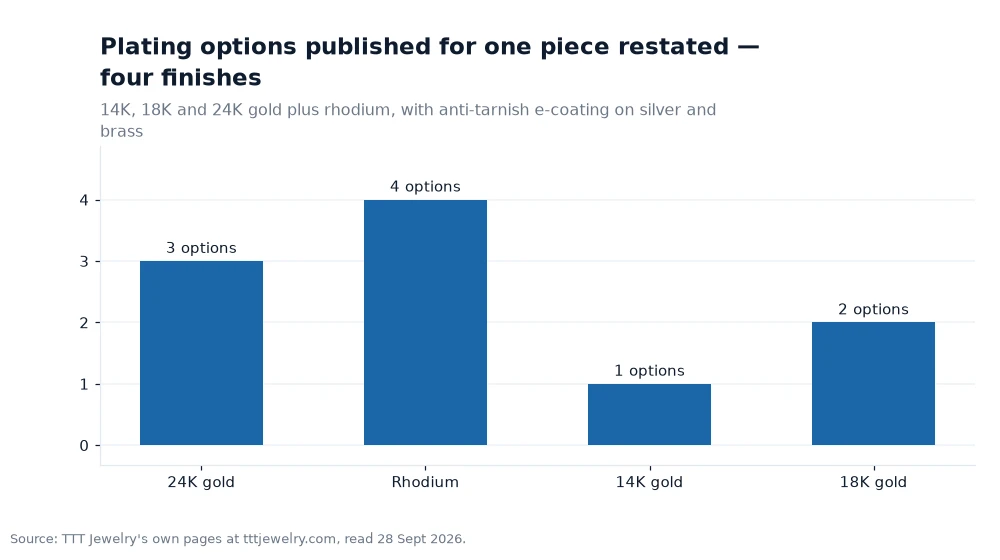
Plating is the option most often left vague, so count it properly. Four precious-metal finishes are published for a single piece: 14K gold, 18K gold, 24K gold and rhodium. Choose one and it applies to the whole run, because electroplating is a batch operation, which means a collection that needs two tones needs two finishing batches.
Now put a number on the risk. If a buyer takes a two-week holiday in the middle of a development calendar that runs 48 hours plus 25–30 days plus 3–4 weeks, that fortnight is roughly 2 ÷ 8.6 = 23% of the total 8.6-week schedule at the slow end. The arithmetic is mine, and it explains why the published 24-hour response standard and the named project manager matter so much: the factory's clock keeps running while the buyer's does not.
Where orders usually stall
Two points account for most delays, and neither is the bench. The first is an unfilled brief: a design without a stated finish or packaging waits while somebody chases an answer. The second is a confirmation that arrives late, because the release of tooling depends on it.
A third is subtler — a buyer comparing a wholesale jewelry OEM services quote with a friend's description of a different supplier's process. The fix is to ask for the stage list in writing, with the windows attached, so the comparison is between documented flows rather than between impressions. A buyer who has the MOQ floors and the stage windows on one page can also tell a custom jewelry wholesale program that is being quoted properly from one that is being improvised.
Frequently asked questions
How many stages does a wholesale order go through?
Five published stages: concept and design, master sampling, quality inspection, sample confirmation and mass production, with inspection running through the process and covering the whole order before delivery.
What happens if I reject the sample?
The sample is adjusted and re-built, which puts the order back into the published 25–30 day sampling window rather than pausing the clock, so it is worth reviewing against the artwork carefully.
When should packaging be specified?
With the rest of the brief, before CAD is finalised, because bespoke packaging design, barcode labelling and backing cards are produced alongside the jewelry rather than after it.
Running the flow in the right order
Sketch the five stages on one page, attach the published windows, and mark who acts at each one. Orders go wrong at the gates, not on the bench. The sterling silver sample testing notes show how a first article is reviewed before a run is released, and the terms and shipping answers cover what happens after the carton leaves.
The details quoted above — the five service steps, followed by the six customisation variables — trace back to the maker's own site at the tttjewelry.com address, checked 28 Sept 2026. The restating of the windows is my own construction, while the source figures stay the client's[1].